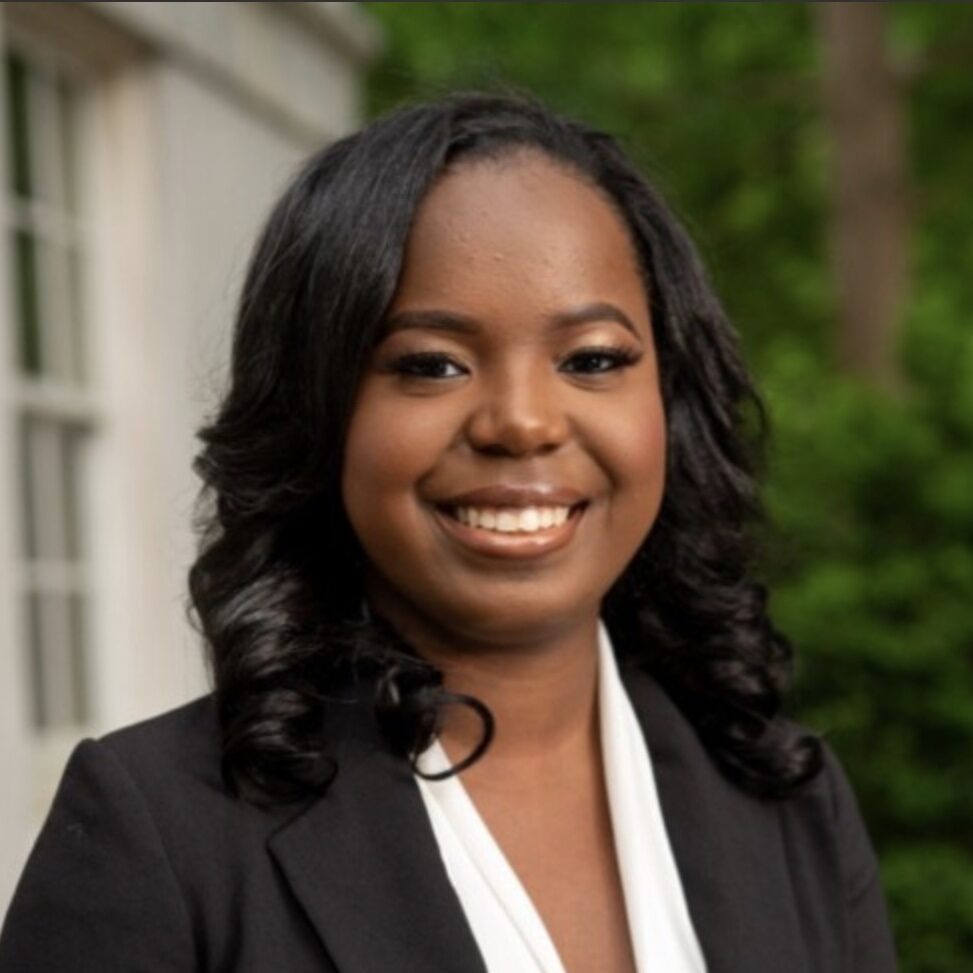
Janae Dunkley
Behavioral, Social, and Health Education Sciences MPH '21
PhD Student in the Department of Epidemiology
What led you to Rollins, and why did you choose Maternal and Child Health?
I went to Emory for my undergraduate degree, and that is where I discovered my passion for Maternal and Child Health. When I was at Emory as a Junior, I took Health 210 — Predictive Health and Society with Dr. Michelle Lampl — and learned about a variety of disciplines ranging from infectious disease to WASH (water, sanitation, and hygiene). The course made me rethink health as something more than biology, but as something deeply shaped by our daily lives and environments.
The lecture Dr. Lampl delivered on maternal and child health truly resonated with me. She discussed the intergenerational effects of health and how the experiences of people who came before us can influence our own health outcomes. I began thinking about my mother and grandmother, and how the challenges that they have faced as Black women in this country compounded across generations. My own community in Georgia has had some of the highest rates of maternal morbidity in the country. My family had also adopted three boys who were impacted by prenatal substance exposure leading to fetal alcohol syndrome and neonatal abstinence syndrome. I often thought about the circumstances surrounding their births and how those early exposures shaped their lives. Reflecting on these experiences made maternal and child health deeply personal.
I knew that the kind of public health impact that I wanted to make was to address adverse health outcomes among vulnerable populations from a life course perspective. I wanted to evaluate how psychosocial, biological, and social health factors interact to shape health over time. After class, I spoke with Dr. Michelle Lampl and was connected to Dr. Lauren Christiansen-Lindquist who has been deeply impactful in my academic journey. At Rollins, I studied Behavioral Social and Health Education Sciences (BSHES) to deepen my understanding of how social and cultural contexts shape population health and how inequities can be addressed through meaningful social change.
What is your current position? What have you enjoyed about the role?
Right now, I am a PhD student in Epidemiology at Emory. The BSHES Master’s program allowed me to approach public health issues through a theoretical lens and gain a better understanding of the factors driving adverse health patterns. I found myself wanting advanced training in statistical and epidemiologic methods, and I wanted to become an expert in my field, so a PhD in Epidemiology seemed like the next best step in my career.
Specifically, my current work centers on understanding factors contributing to racial disparities in maternal morbidity and hypertension. Psychosocial stress and traumatic experiences across the life course have the potential to shape health outcomes, and these inequities are transmitted across generations. I am also interested in exploring how accelerated epigenetic aging may contribute to the racial disparities observed in adverse pregnancy outcomes.
In my research assistantship with Dr. Shakira Suglia, I am working with SOL data to understand the relationship between accelerated epigenetic aging and hypertensive disorders of pregnancy among Hispanic women. I am also working on a pilot home intervention for post-partum women designed to promote cardiovascular health among mothers. Academically, I am learning some really great methods, taking courses such as psychosocial epidemiology, and serving as a teaching assistant for a structural interventions course.
How did your Rollins degree or education prepare you for this position?
The BSHES program provided me with a framework for understanding and developing interventions, understanding how the patterns that we observe in maternal health outcomes come about, and how to interpret complex health behaviors. Having this framework is necessary for understanding how root causes of inequity manifest and how to address it. Professionally, the master’s program required us to engage in research assistantship positions. I was provided with numerous opportunities to grow as a professional in maternal and child health. I had the chance to work in clinical, nonprofit, state, and federal sectors while doing my master’s program.
I was not necessarily working in the realm of maternal morbidity and mortality in my master’s program but did have the opportunity to collaborate on some projects that were very important to me. I worked at Children’s Health of Atlanta on healthcare quality improvement projects among pediatric patients with congenital heart defects, conducted qualitative research at Sister Love to examine reception of medication abortion among Black and Hispanic women, and was a contact tracer during Covid for the Georgia Department of Health. I also spent four years at the CDC, first as a graduate research assistant and then as an ORISE fellow. In this role, I contributed to multiple research projects focusing on prenatal substance exposure and alcohol use among women of reproductive age. I was able to co-author multiple papers and had the opportunity to serve as first author on a manuscript published in Maternal and Child Health Journal. The paper examined clinician screening practices for prenatal alcohol exposure among pediatric patients.
Those were all great experiences that came about because I was involved in a program that nurtured me academically and professionally. Rollins provided a hub to engage in multiple sectors and projects with easy access. Engaging in these opportunities gave me the hard skills that I needed to address the questions that are important to me. In my current PhD program, I am learning techniques that are making me well-rounded to approach designing epidemiologic studies and analyses more thoughtfully and thoroughly.
What accomplishment or project are you most proud of during or after your time at Rollins?
It would definitely be publishing my first paper! That was a painstaking process, but I grew so much. I learned how to see a project from start to completion, leading the team meetings for the analysis, presenting my progress, and getting feedback from experts. I gained mentorship from co-authors that had a wealth of experience and knowledge to make my analytic skills much greater. I learned how to truly write and produce an academic manuscript and see it through the process. That was an invaluable experience that I will need to carry with me through my career. It provided me with the opportunity to contribute to work that is really important to me.
I also learned the importance of early screening practices and barriers contributing to clinicians not engaging in screening for prenatal alcohol exposure, and how that leads to the underdiagnosis of children with fetal alcohol spectrum disorders. This ultimately impedes their life potential, since early intervention is so important to provide kids with resources that will support them. I was able to take the information back to my family to inform how we approach the care for our boys. That is what it is all about for me – making a difference in the lives of those who are close to me.
What advice do you have for current and future MCH Certificate students who want to improve our MCH landscape?
My number one piece of advice would be to tap into the network that surrounds you. The faculty here are stellar, and they are experts within their field. Whatever you have been through, they have gone through that plus more, and there is a wealth of knowledge and mentorship to get you to whatever place you are wanting to be.
Truly, the faculty is so supportive in helping students reach their research goals. Attend office hours just to speak to the professor and get to know them more. Tell them anything that you are struggling with and anything you are curious about. You never know who they could connect you to!
What do you enjoy doing most outside of public health?
I really enjoy hiking. Over the summer, I was in Seattle and hiked Mount Rainier. When I’m here, locally I like hiking Stone Mountain or Arabia Mountain for an easier stroll. I really like getting out in nature and clearing my head, with no phone and grounding myself in reality. Beyond that, I really like spending time with my friends and family exploring Atlanta, walking the Beltline, reading, and cooking.