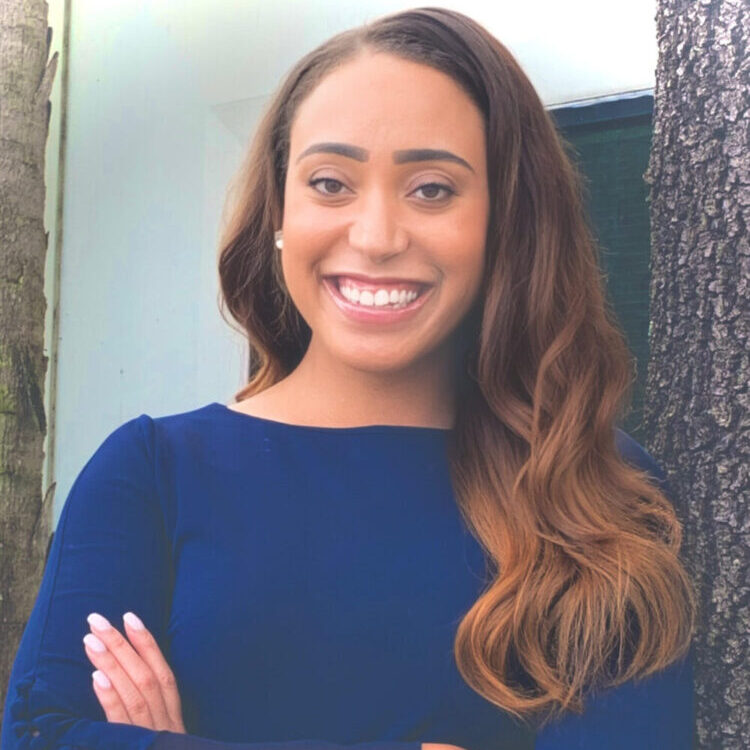
Faythe Edmunds
Behavioral, Social, and Health Education Sciences '18
Senior Population Health Strategy Consultant at CareFirst BlueCross BlueShield
Why did you choose BSHES as your concentration, and why did you choose to pair it with the MCH Certificate?
Choosing BSHES as my concentration felt like a natural extension of my academic foundation in sociology and public health. I have always been drawn to understanding societal trends and the underlying factors that shape how individuals and communities make health-related decisions. I wanted to build on that curiosity in a way that was not only theoretical, but also practical, learning how to translate insight into action and show up in this field in a meaningful way. BSHES gave me the tools to think critically about behavior, systems, and the longstanding barriers that influence health outcomes.
Pairing that with the MCH Certificate was equally intuitive. My commitment to maternal and infant health equity has been persistent, and even prior to Rollins, I was exploring topics such as Black racial disparities in maternal and infant mortality, breastfeeding practices, and perceptions of risk related to adverse outcomes in the U.S. During that time, much of the research that fueled my interest was authored by Dr. Carol Hogue, so the opportunity to learn from her directly was incredibly meaningful to me.
I entered Rollins knowing that I wanted to remain in the maternal and child health sphere long-term. The MCH Certificate allowed me to deepen my knowledge in the sector’s core focus areas while also strengthening my ability to contribute in a way that is both informed and impactful.
What is your current position, and how does it relate to maternal and child health?
I currently serve as a Senior Population Health Strategy Consultant at CareFirst BlueCross BlueShield, where I focus on the OB/GYN specialty. In this role, I manage the maternity episode-of-care portfolio, a value-based program that spans all healthcare services provided during pregnancy and a defined postpartum period.
My work sits at the intersection of data, strategy, and clinical partnership. I collaborate closely with both executives and physicians to identify opportunities to improve accessibility, affordability, and equity in the care they deliver. This often involves analyzing performance data, identifying gaps in outcomes, and co-developing strategies that support patients more effectively across the full continuum of care and the structures that shape patient experiences.
What makes this work especially meaningful is its direct connection to maternal and child health outcomes at scale. Rather than focusing on individual encounters alone, we are working to reshape systems of care in ways that better support birthing individuals and their infants. It requires us to think critically about the structural and clinical drivers of disparities, and to design solutions that are not only evidence-based, but feasible and continuous within clinical settings.
How did your Rollins education prepare you for your position as a Population Health Strategy Consultant?
My Rollins education prepared me for my current role in countless ways. I often find myself drawing on nearly everything I learned, which is part of what makes my work so fulfilling. One of the most impactful aspects was learning how to integrate multiple skill sets at once because that is exactly what my work requires.
On any given day, I am drawing on quantitative and qualitative data analysis, stakeholder engagement, clinical research, and strategic communication. A significant part of my role involves translating complex data into clear, actionable insights for clinical audiences, which requires both technical expertise and the ability to communicate in a way that resonates and drives change.
Beyond the technical skills, Rollins shaped how I approach problem-solving. I learned to look beyond the data to understand the broader context, especially the systemic and human factors that influence outcomes. In my current work, one of the most common challenges is standardizing workflows across multiple practices. While this can initially seem like an operational issue, it is often deeply rooted in provider preferences, established habits, and varying approaches to care.
Because of that, I approach the physicians and care teams as partners and experts in their space. Their perspectives, and even their pushback, are essential to ensuring that the strategies we develop are practical, respectful, and sustainable. That mindset was reinforced throughout my time at Rollins.
I also deeply valued the opportunities to engage with community-based organizations and to work collaboratively on group projects. Those experiences strengthened my appreciation for shared ownership and collective problem-solving. They showed me that when addressing complex public health challenges, the ability to listen, adapt, and build with others is just as important as any technical skill.
What advice do you have for current and future MCH certificate students?
While you are in school, do not underestimate the significance of both your experiences and the relationships you build along the way. Some of the most defining opportunities can come from places you may not initially expect. The position I accepted immediately after graduation, for example, came directly from an assignment I worked on with an organization during my time at Rollins—something that started as coursework and evolved into a career pathway.
I also had the opportunity to work as a research assistant, and that experience completely shifted my perspective on what it means to “do good” in this field. It challenged me to think more critically, but also more personally, about impact. I would encourage you to seek out work that not only strengthens your academic proficiency, but also grounds you in genuine human connection. That balance is what will sustain you. Long after graduation, those experiences will stay with you and serve as a reminder of why you chose this path in the first place.
It is also important to remain open. While having a specific area of interest within MCH is valuable, try not to limit yourself by avoiding spaces that feel unfamiliar. Some of the most meaningful growth happens when you allow yourself to step outside of your comfort zone. Prioritize building transferable skills whenever you can, as they will open doors in ways you may not anticipate.
Most importantly, believe in yourself and what you are capable of, especially in the moments when you feel uncertain or not fully prepared. In my experience, those have been the times that have led to the most growth and been the most gratifying. Apply for opportunities that feel like a stretch, be intentional about building connections with people whose work inspires you, and do not hesitate to step into leadership.
What do you enjoy doing most outside of public health?
Baking is one of my favorite ways to unwind and recharge. I’m drawn to the level of detail and precision it requires because it forces me to slow down and be fully present, which I find really therapeutic. I also enjoy experimenting with different flavor profiles and trying new recipes, especially when I can share the results with others. Baking has become one of the ways I express care for the people in my life. There’s something incredibly special about creating something from scratch, gifting it to someone else, and being able to experience their reaction.
I’m a big fan of pretty much all of the television competitions and my favorite isThe Great British Baking Show! I love the creativity and structure of it, but also the sense of community and encouragement among the contestants. It’s something that I find both entertaining and inspiring to tune into when I need a pick-me-up.