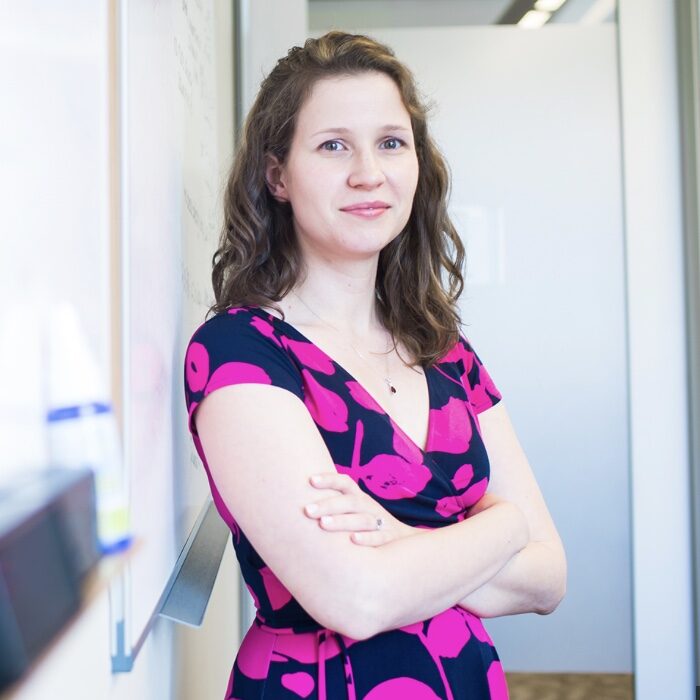
Dr. Lauren Christiansen-Lindquist
Associate Professor in Epidemiology and Associate Dean for Education
April 4, 2026
What initially drew you to the field of public health, and specifically to maternal and child health?
I was drawn to public health because I was always a math nerd. I was excited about epidemiology because it was an opportunity to apply my quantitative and analytic strengths to improve the health and well-being of large populations. While folks sometimes come to public health with a topic that is really of interest to them, that was not my experience. Instead, I was drawn to the methodology and the ability to apply to “use my powers for good” to apply the skills I would learn to whatever setting would be most useful.
I started out at the CDC in the Division of STD Prevention, and I really liked the work that I did there. When I applied to our doctoral program, I was envisioning that I was going to stay in that zone and perhaps look a little bit more at the health of individuals who are incarcerated. In the second year of my PhD program, our first son was born. That was a really pivotal experience for all kinds of reasons. I was filling out his birth certificate in the hospital and knew that we use these data for public health studies. I was shocked at some of the questions that they were asking moms or people who had just delivered a baby. Most of them were easy enough to respond to, but some of them were a little bit more technical and included vocabulary that people might not know. I couldn’t help myself, and I started thinking about the data quality issues that might arise from asking these types of questions at a time where people are juggling so many things. They’re just physically and emotionally exhausted — how good could these data be?
I wrote an email to my advisor from the hospital because I didn’t want to forget about it!. I told her that I wanted to do research related to birth certificate data quality. She told me that folks have done a lot of work in this space, and that if I really want to make a difference, I should study stillbirth. I was very resistant at first, and felt that the topic was too depressing, and it hit too close to home. My baby was only 3 months old by the time we were having this conversation. All of the topics that we deal with in public health are sad and difficult in one way or another, because we’re trying to prevent people from getting sick or dying, but this particular topic felt so heavy. I told her that I would learn, read, and think about it to see what might happen.
Our dissertations in epidemiology are segmented into 3 different parts. At first, a third of my dissertation was going to be on stillbirth. And then it was two-thirds, and eventually it was the whole thing. I really never looked back, because my advisor was absolutely right. If I wanted to make a difference, this was a place where I could do it. Thinking back to what I said before, I wanted to come to public health to use my skills for good, and to make a difference. I’ve had the chance to meet some incredible parents who have walked a journey that I truly can only imagine how difficult it is. It has been an honor to work in this space.
Can you talk a little bit about your work in stillbirth prevention and reporting, and some specific areas that you’ve focused on?
My time right now is split between academic administration and teaching, but the work that I have done in the research and public health practice space is in stillbirth. I led research that was formative for helping the CDC learn whether it was feasible to expand the Pregnancy Risk Assessment Monitoring System (PRAMS) to include stillbirth. It was something that they had been thinking about doing for a long time, but the prevailing thought had been that it was too difficult, and that women wouldn’t want to respond, so they had not pursued it. In partnership with my dissertation chair, Dr. Carol Hogue, who founded PRAMS when she was the division director of CDC’s Division of Reproductive Health, we came to CDC and said “how about we let those who have had a stillbirth decide, and not decide for them.” The response – both from CDC and bereaved parents – was really remarkable. I led the pilot work that ultimately prompted CDC to create an RFA for states to apply for special funding to include stillbirth in their PRAMS surveillance. It has been implemented in a handful of states and has been successful in the places where it has landed.
Of course, the current situation with PRAMS and the vision of reproductive health is difficult and concerning. It seems like the participating states have the funds to continue the ongoing surveillance. The challenge is that the infrastructure that supported their work is not in place anymore, and there are concerns about states having the technical skills to get the data in a way that is usable and can be analyzed. PRAMS was so great because not only were the states getting their own data back, but CDC had access to the data across all of the participating sites. Researchers could request the data to be used for different manuscripts that they wanted to write or questions that they had. The sites have relied heavily on these data to inform their maternal and child health programming.
What do you see as the most important next steps in stillbirth prevention and improving how we understand and respond to stillbirth in the U.S.?
We truly need federal legislation to address the key shortcomings that inhibit our progress. The U.S. lags behind other high-income countries with our stillbirth rates, so there is a need to improve our data collection and educate folks about stillbirth. Unfortunately, stillbirth is something that many people don’t know exists, or if they do, there’s often an assumption that it either doesn’t occur in the US or that all stillbirths are inevitable. There is also a need to improve people’s access to evaluations to find out why a stillbirth happened. Autopsy rates are low in the U.S. for a lot of reasons. One of them is we just don’t have enough pathologists who have the requisite training to perform the autopsies, and some additional work is needed to bolster the workforce to have more perinatal pathologists in the country.
I have partnered with a dear friend of mine whose daughter, Autumn, was stillborn just a few months after my oldest son was born. She has been on a journey to prevent other families from facing the same tragedy that hers has. She’s worked to pursue legislation at different levels, and I’ve worked closely with her to provide data and the public health perspective behind legislation. The SHINE for Autumn Act has been reintroduced in both the House and the Senate this legislative session. We are on the third attempt to get it passed. This has been challenging, but the partnership with her has been really incredible. I have learned so much. She has learned so much. We’ve talked to various staffers in the House and the Senate, and we’re moving the conversation forward every time. That’s always a win, but we cannot wait to see it finally get over the line.
What have you learned from your students in the classroom?
I learn so much from my students, and in the classroom is truly my favorite part of my job. I was recently appointed our new Associate Dean for Education at the School of Public Health, and a lot of folks have asked if I’m going to continue teaching – I most certainly will!
Because of my quantitative focus, I can sometimes get lost in the methodologic details and lose sight of the big picture. This was a particular challenge for me earlier in my career. Working with my students and hearing their stories about why they came to public health, or their topics of interest, has helped me pull out the details to connect with them. We discuss why some of these nitty-gritty things are important and think about the ways in which they are going to use these skills once they graduate.
What advice would you give to students or early-career professionals interested in maternal and child health?
Especially situated in this moment, I would encourage students and early career professionals to frequently remind themselves about why they came to public health in the first place. As we’re facing all kinds of different challenges, the world feels heavy, because it is. It can feel like you want to give up, and it’s easy to lose hope. I think it’s so important to remember why you came to do this work. What brought you here? What are the things that are dear to your heart? How do you want to make a change?
Our students are working on all kinds of homework assignments across different classes, and some of it can feel meaningless in the scheme of things, especially as you look around and feel like the world is on fire. It is such an important part of your path to get the skills and credentials to do the work that you wanted to do. That’s why I think it’s so important to remind ourselves about why we came to do this work, and recognize that even as we’re slogging through assignments that seem meaningless, they are all meticulously planned as part of the training to get you to where you want to be, and do the work that you want to do.
I also think that we need to be creative. Public health has always been a creative field. We have always done far more than we probably should have been able to do, given the resources that were available to us. We’ve been creative about our approaches, and it is that creativity that has pulled us through. The skills that our students are getting now are more important than they ever have been. Continuing to push forward as much as you can and taking care of yourself along the way is so important. None of us are superhuman, and we all have to pause and take care of ourselves. Find the things that bring you joy. For me, that’s been embroidery lately – it helps me to slow down to do something creative and calms my mind.